
Reviewed · MONGOLIA HORSE RIDING TOURS
Mongolia Nomad Trek • On-Foot & Horseback ~ 15 Day
The most unusual part of this 15-day Altai expedition is the choice built into each day: you can hike, ride, or combine both as the route crosses river valleys, alpine woods, open steppe, and high passes near Mongolia’s borders with China and Russia. Eddie Frank leads the trek, with local Kazakh horsemen and a Mongolian guide providing the cultural connection and practical support.
I like the horse-riding clinics, which make this more approachable if you are not already a confident rider. I also like the genuine village encounters: Kazakh families in their gers, traditional horse games, Tuvan communities, eagle hunters, handmade crafts, and ancient rock art all appear along the way.
The main drawback is the physical demand. You will spend long hours in vehicles and on foot, climb to more than 10,000 feet, cross rough ground, and possibly walk through snow. At $8,250 per person, this is a major investment, so you should want a remote expedition rather than a comfortable sightseeing holiday.
Key things to know before choosing this trek
- Two ways to cross the Altai: Hike the route, ride Mongolian horses, or alternate between the two.
- Eddie Frank leads the adventure: Regular riding instruction is included, using Australian saddles.
- The cultural encounters are central: Meet Kazakh and Tuvan families, watch horse games, seek out eagle hunters, and shop for handmade crafts.
- The route reaches serious altitude: The trek climbs to a 10,350-foot pass and visits Potanin Glacier below Khuiten Peak.
- Remote camping is part of the deal: Camels carry expedition gear, while you sleep in camps near lakes, rivers, gorges, and glaciers.
- The trip begins and ends in Ulaanbaatar: Domestic flights connect the capital with Bayan Ulgii in western Mongolia.
Why the Altai route feels so different
Mongolia’s western Altai region is a long way from the capital in both miles and mood. Ulaanbaatar gives you a useful start, with hotels, museums, restaurants, cashmere shops, and a national theater performance. Then a three-hour flight carries you to Bayan Ulgii, where the trip changes from city visit to remote mountain expedition.
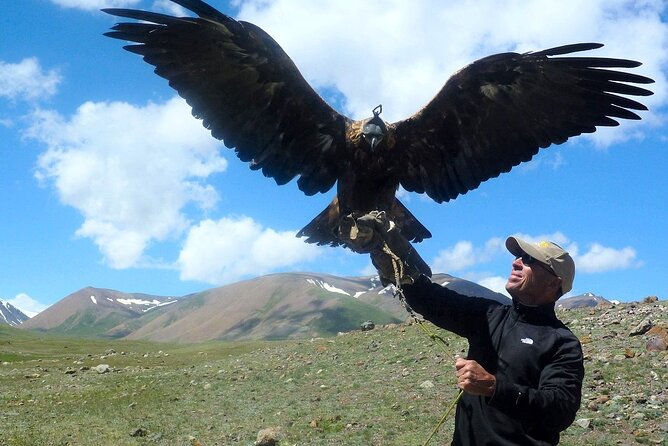
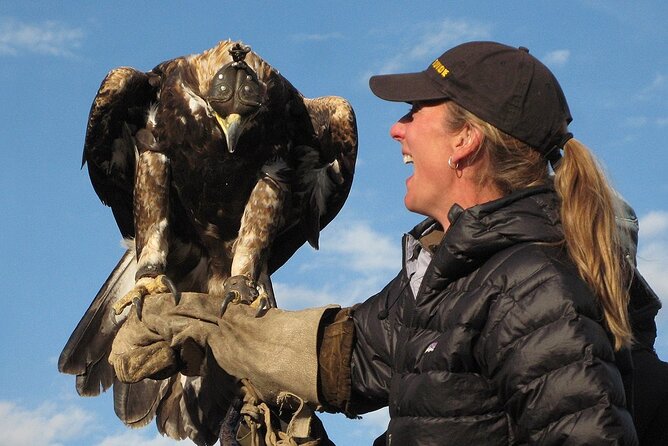
The Altai route passes through the territory of Kazakh nomads, whose culture differs from that of central Mongolia. Golden Eagle hunting is one of the most memorable details here. You may meet a local hunter and see the bird up close, an encounter that connects present-day life with a tradition still practiced in the region.
The setting changes constantly. Khoton Lake gives you forest and open water. The Tsagaan Us and Tsagaan Gol rivers lead into broad valleys and steep gorges. Higher up, the trees thin out and the route reaches tundra, lichen-covered rock, mountain swamps, and glaciers.
This is not a polished resort circuit. The appeal is the scale, silence, and direct contact with people who still live by herding, riding, and seasonal movement. The trade-off is that roads are rough, facilities are basic, and weather can alter the plan.
More mongolia horse riding tours in Ulaanbaatar:
- Horseback Riding Tour to Turtle Rock & Aryabal
★ 5.0 · 54 reviews - Terelj National Park: Tour with horse riding and hiking
★ 5.0 · 46 reviews - Horse riding experience in Terelj National park 1 day
★ 4.8 · 30 reviews
Days 1 and 2: Ulaanbaatar gives you a soft landing
Your trip begins in Ulaanbaatar, at about 4,429 feet. A Mongolian guide meets you at Buyant Uhaa Airport and takes you to the Tuushin Hotel, where you spend two nights.
The first day is deliberately light. You can rest, walk through the capital, or explore with other members of your private group. That free time matters because the western part of the trip will be physically demanding and far less predictable.
Day 2 is set aside for city discovery. You can choose among museums, food stalls, restaurants, shops, and local cashmere clothing. In the evening, your guide takes you to the State Academic Theatre of Opera and Dance for a two-hour cultural performance with traditional music and colorful costumes.
I see this opening as more than filler. It gives you a practical introduction to Mongolia before you head into the countryside. Still, two nights in the capital may feel short if you want a serious look at Ulaanbaatar.
Day 3: Flying west to Bayan Ulgii
The three-hour flight to Bayan Ulgii is the key transition of the trip. At 5,610 feet, the town already sits higher than Ulaanbaatar, and the surrounding province has a strong Kazakh identity.
You leave your main gear at a ger camp, a lodging area modeled on traditional nomadic camps, then visit the outdoor market. The market is a useful place to see everyday local trade before the route becomes very remote.
There is also an effort to locate a local Kazakh eagle hunter. If the meeting works out, you get a close look at one of the region’s most distinctive traditions. Later, you repack your clothing and equipment into waterproof Tusker duffels. Camels carry these duffels during the trek, so careful packing is important.
This is one of the trip’s practical pressure points. You need to be comfortable living out of a limited amount of gear for several days. The duffels are designed for the expedition, but the changeover means your belongings will be packed and handled in a different way than on a normal hotel tour.
Day 4: Khoton Lake marks the true beginning
A seven to eight-hour drive takes you southwest through Tsengel and across the Khovd River to Khoton Nuur, also called Khoton Lake. The long drive is not a minor transfer. It is a full day in the vehicle, and rough roads may make the journey tiring.
Once camp is set beside the lake, you meet the nomadic trekking crew. Camels become part of the support system, carrying equipment as the group moves through the mountains. Dinner at camp marks the start of the expedition proper.
Khoton Lake sits at about 6,820 feet, surrounded by forest and high mountain country. The setting is a fine introduction to the route, but you should not expect a formal lodge or quick access to town. This is remote camping from the start.
More mongolia nomad family homestays in Ulaanbaatar:
- Overnight Semi-Gobi Tour with Nomadic HomeStay
★ 4.5 · 6 reviews - 5 day Central Mongolia and Nomad stay tour
★ 3.5 · 4 reviews - Nomad Family Home Stay in Arkhangai Province
★ 5.0 · 3 reviews
Day 5: Riding lessons, gers, and the Tusker Nadaam
After breakfast beside Khoton Lake, Eddie gives a basic lesson in riding Mongolian horses. The group uses Australian saddles, which provide a familiar design for some riders, though the experience remains very different from riding in a stable or arena.
You then take a slow ride through the forested area above the lake. This first outing is especially useful if you are new to horseback riding. Eddie’s riding clinics are a real strength of the trip because they help you gain enough confidence to take part instead of watching from the side.
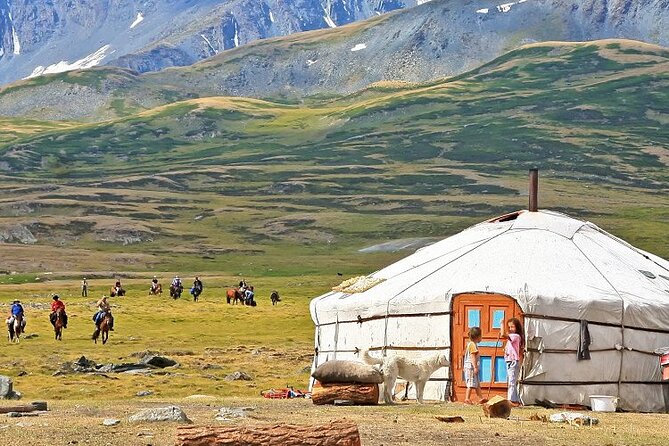
The cultural portion of the day takes you into nearby gers, where local Kazakh families share elements of their traditions. You also attend the Tusker Nadaam, a set of traditional nomadic horse games. Local women display handmade crafts afterward, giving you a chance to buy meaningful gifts directly from the community.
This day also shows the trip’s rhythm: physical activity, local contact, and a camp dinner, rather than a long list of formal attractions.
Days 6 to 8: Following rivers through forest and gorge
Day 6 covers about 13 miles in five to six hours, heading north through alpine forest. The route passes the glacial depression holding Khoton Lake, where horizontal benches show former water levels created by repeated glacial dams.
The Tsagaan Us River flows south from the Tavn Bogd glaciers and is one of three tributaries feeding Khoton Lake. Details like this give the walking route more meaning. You are not simply crossing attractive country. You are following a river system shaped by ice and changing water levels.
On Day 7, you cross to the eastern side of the Tsagaan Gol River and climb through its valley. The day covers about nine miles in four to five hours, ending at Cheben Hill, around 7,050 feet. From camp, you look down on grassy plains, ger camps, and goats.
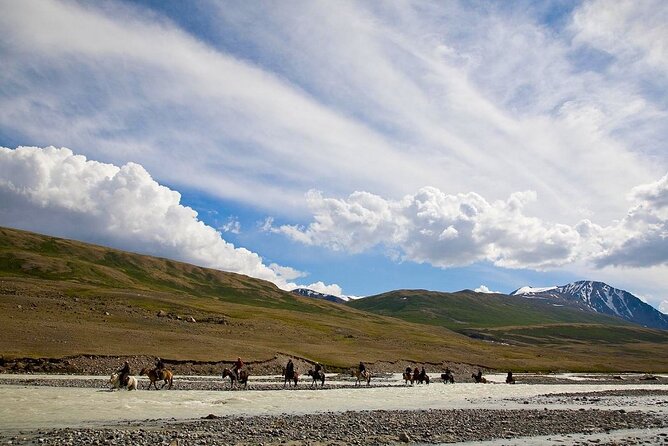
Day 8 is longer, covering roughly 12 miles in seven to eight hours. You descend Cheben Hill, enter the river gorge, and continue along its eastern bank. Flooding can force hikers onto higher ground, while riders may continue beside the water. The route finishes in a broad valley below snow-capped mountains, with the white Tsagaan River flowing in front of camp.
This section is a good example of the tour’s flexibility. Hiking and riding groups may use different lines when water levels or terrain require it. You still share the same camps and overall route, but the day may feel different depending on your chosen pace and mode of travel.
Day 9: A high pass and possible snow
Day 9 is one of the hardest and most memorable stages. You leave the river gorge and climb toward a 10,350-foot mountain pass. The day covers only about seven miles, but it takes eight to nine hours because of the steep ascent and altitude.
From the pass, you get views toward the Sheveet Uul gorge. If recent precipitation has fallen as snow, the group may need to clear a route by hand. That possibility tells you exactly what kind of trip this is: weather and mountain conditions are active parts of the plan.
The descent is steep, and you continue on foot to Sheveed Uul Gorge. Even riders should expect to walk portions of this day. You need strong fitness, steady footing, and patience with slow progress.
Day 10: Tuvan culture and ancient petroglyphs
The next day trends downhill and covers about seven miles in six to seven hours. The group stops at a small ger community to meet Tuvan people, whose traditional beliefs include shamanism.
The cultural contact here is different from the Kazakh encounters near Khoton Lake. That variety matters. Mongolia is not one single nomadic culture, and the route gives you several glimpses into the region’s different communities.
At lunch, you see ancient petroglyphs in the Mongolian Altai. Some images date back roughly 11,000 years, with later carvings continuing into the ninth century. The rock art depicts old cultural scenes and makes the surrounding valleys feel like a record of human life rather than an empty wilderness.
After a steep descent into the Tsagaan Gol valley, you camp for two nights with views toward glaciers and high peaks. This is a well-placed overnight stop, since the following day is reserved for rest.
Day 11: A needed rest day at 7,870 feet
The rest day includes a scenic hike to a lake on a nearby plateau. You also have time for laundry and relaxation at camp.
Do not underestimate the value of this pause. By now you have crossed rough ground, climbed and descended steep sections, and spent long hours outdoors. A day without a major transfer or major climb helps you recover before the route heads toward Potanin Glacier.
The elevation remains about 7,870 feet, so rest does not mean a return to low altitude. You should continue to pace yourself, drink regularly, and follow the guide’s advice.
Day 12: Potanin Glacier beneath Mongolia’s highest peak
Day 12 is another demanding stage, lasting six to seven hours and covering about nine miles. The route climbs over frost-heaved ground toward Potanin Glacier in the Altai Tavn Bogd.
The glacier lies below Khuiten Peak, which rises to 14,350 feet and is Mongolia’s highest point. Nairamdal Peak reaches 13,392 feet and marks the meeting point of Mongolia, Russia, and China.
Above the tree line, the surroundings become harsher. You pass alpine meadows, tundra, lichen-covered rocks, and high mountain swamps. Few animal species live in these conditions, and the absence of trees makes the scale of the peaks more apparent.
This is a day for strong walkers. The trip does not describe technical glacier climbing, but it does involve high elevation and rough uphill ground. Horseback riding may not remove all the difficulty, since some sections and viewpoints require walking.
Day 13: The final trail and the ride back
The final trail day takes you north and east toward the national park ranger station gate. The route then shifts into a six to seven-hour drive back toward Bayan Ulgii.
Before leaving the trail, you have one last chance to ride freely and let your horse run. The camels are unloaded, vehicles meet the group, and you return to the ger camp for the night.
This day has a noticeable ending point. You are leaving the high peaks and returning to roads, vehicles, and scheduled flights. It can also be tiring, since the trail finish and long drive are packed into the same day.
Days 14 and 15: Back to the capital and onward
A short drive brings you to Ulgii airport for the three-hour flight back to Ulaanbaatar. You return to the Tuushin Hotel and have one final night in the capital.
That evening gives you time to go out for dinner and adjust to city life after many nights in remote camps. Day 15 is devoted to your transfer to Chinggis Khaan International Airport and onward plans.
The schedule includes breakfast, lunch, and dinner on 13 days, along with private transportation. Flights within Mongolia are part of the planned route, while the cost of reaching Mongolia from your home country is not included.
What $8,250 buys you
At $8,250 per person, this is expensive in simple dollar terms. The price makes more sense if you value a private expedition with a lead guide, local horsemen, camel support, domestic flights, remote camping, meals, private transport, and a carefully connected route through a difficult-to-reach part of Mongolia.
You are also paying for logistics that would be hard to arrange independently. The expedition needs animals, camp equipment, local crews, vehicles, flights, and timing across mountain roads. That support is the difference between simply reaching western Mongolia and moving through it for nearly two weeks.
Still, the price does not buy luxury. You should expect basic camp living, long transfers, changing weather, and physical work. If your ideal Mongolia trip includes comfortable hotels, short drives, and easy access to attractions, this is not good value for you.
Who should book this adventure
I would recommend it to a fit, curious person who wants Mongolia through movement and contact with local communities. It suits riders who want instruction, experienced equestrians who want long open-country riding, and hikers willing to share the route with horses and camels.
It also works for a private group that values flexibility. The activity is private, so only your group participates, though no fixed group size is provided. A father and daughter, a group of friends, or a small circle of seasoned adventure companions could all find the format appealing.
I would hesitate to recommend it if you dislike rough roads, remote camps, high altitude, or uncertain weather. The tour requires a strong physical fitness level, and the mountain pass, glacier approach, and long driving days are not optional background details.
Free cancellation is available up to 24 hours before the start time. Weather or minimum participation can also affect departure, with a different date or a full refund offered in those cases.
Should you book the Mongolia Nomad Trek?
Book it if you want a demanding mountain journey tied to living nomadic traditions, not a standard sightseeing tour. The combination of riding lessons, Kazakh hospitality, eagle hunting, horse games, Tuvan culture, petroglyphs, glacial valleys, and high passes is unusually broad.
Skip it if you want comfort or a relaxed pace. For the right person, the cost buys access, support, and a rare route. For the wrong person, 15 days of rough travel and high-altitude trekking would feel like work. Know which kind of trip you are choosing before you pay.
FAQ
Where does the Mongolia Nomad Trek begin?
The experience begins in Ulaanbaatar, with pickup offered from Buyant Uhaa Airport. The first two nights are at the Tuushin Hotel.
How long is the tour?
The tour lasts approximately 15 days, beginning in Ulaanbaatar and ending with a transfer to Chinggis Khaan International Airport.
Do I need previous horseback riding experience?
Previous riding experience is not stated as a requirement. Eddie Frank provides regular riding clinics and gives you basic instruction using Australian saddles.
How physically fit do I need to be?
You should have a strong physical fitness level. The route includes long hiking days, rough ground, steep climbs and descents, a 10,350-foot mountain pass, and an approach to Potanin Glacier.
What meals and transportation are included?
Private transportation is included, along with breakfast, lunch, and dinner on 13 days. Travel from your home country to Mongolia and back is not included.
Can the tour be canceled because of weather?
Yes. The experience requires good weather. If it is canceled because of poor weather or because the minimum number of participants is not met, you are offered another date or experience, or a full refund.
More Hiking & Trekking in Ulaanbaatar
- 1 Day Manzushir Monastery & Hiking to Tsetsee Gun (Bogd Khan Summit)
★ 5.0 · 14 reviews - Mongolia Trekking Tour in the Altai Tavan Bogd National Park
★ 5.0 · 4 reviews
More Horses in Ulaanbaatar
- MONGOLIAN NOMADS: 2-Day Horse Trekking & Cow Milking Tour
★ 4.8 · 23 reviews - Full Day Private Tour in Terelj National Park with Horse Riding
★ 5.0 · 13 reviews - 1 Day Semi-Gobi Tour with Lunch And Enjoying Camel or Horseback
★ 5.0 · 9 reviews - 2 Day Horse trekking in Terelj national park
★ 4.3 · 5 reviews
Just added around Ulaanbaatar
- Ulaanbaatar: 4-Day Central Mongolia Winter Tour★ 5.0 · 3 reviews
- Ulaanbaatar Signature Tour – Mongolia’s Capital in One Day★ 4.3 · 3 reviews
- Private – Ulaanbaatar City Tour★ 3.5 · 3 reviews
- A Day Authentic Mongolian Trip near Ulaanbaatar all-inclusive★ 5.0 · 3 reviews
- Transfer service to Terelj national park★ 5.0 · 3 reviews
- Private Departure Transfer: Ulaanbaatar Airport★ 4.5 · 3 reviews
- Private Tandem Paragliding Experience at Bayanzurkh Mountain★ 5.0 · 3 reviews
- Essence of Mongolia 5 Days★ 5.0 · 3 reviews
Mongolia Horse Riding Tours, compared.
Terelj National Park: Tour with horse riding and hiking
Read our review →
Horse riding experience in Terelj National park 1 day
Read our review →
Full Day Private Tour in Terelj National Park with Horse Riding
Read our review →
1 Day Semi-Gobi Tour with Lunch And Enjoying Camel or Horseback
Read our review →Browse the lists this tour appears in